Mad Honey Nepal: Origins, Effects, Safety and Where to Buy
Shop this story on Avendi
See all →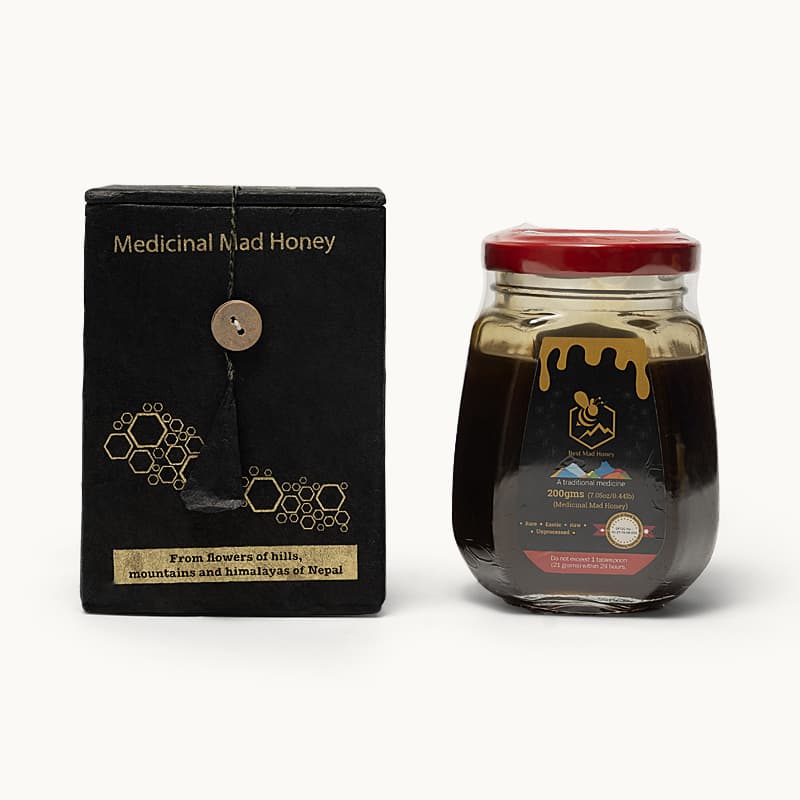
High on the cliffs of the Nepali Himalaya, the world’s largest honey bee builds its combs on sheer rock faces. Twice a year, hunters climb rope ladders to cut them down. The reddish, faintly bitter honey they carry home is no ordinary sweetener. It is mad honey — a rare wild honey that carries a natural buzz. People have prized it for centuries as a folk medicine, and the world now seeks it out. It is also widely faked, often misunderstood, and easy to misuse.
This guide explains what mad honey actually is. It shows how Nepal’s giant cliff bees make it, and what it does to your body — the warming folk effect at a small dose, and the real risks at a large one. It also shows you how to spot the genuine article, and where to buy it. So let’s start with the basics.
What Is Mad Honey?
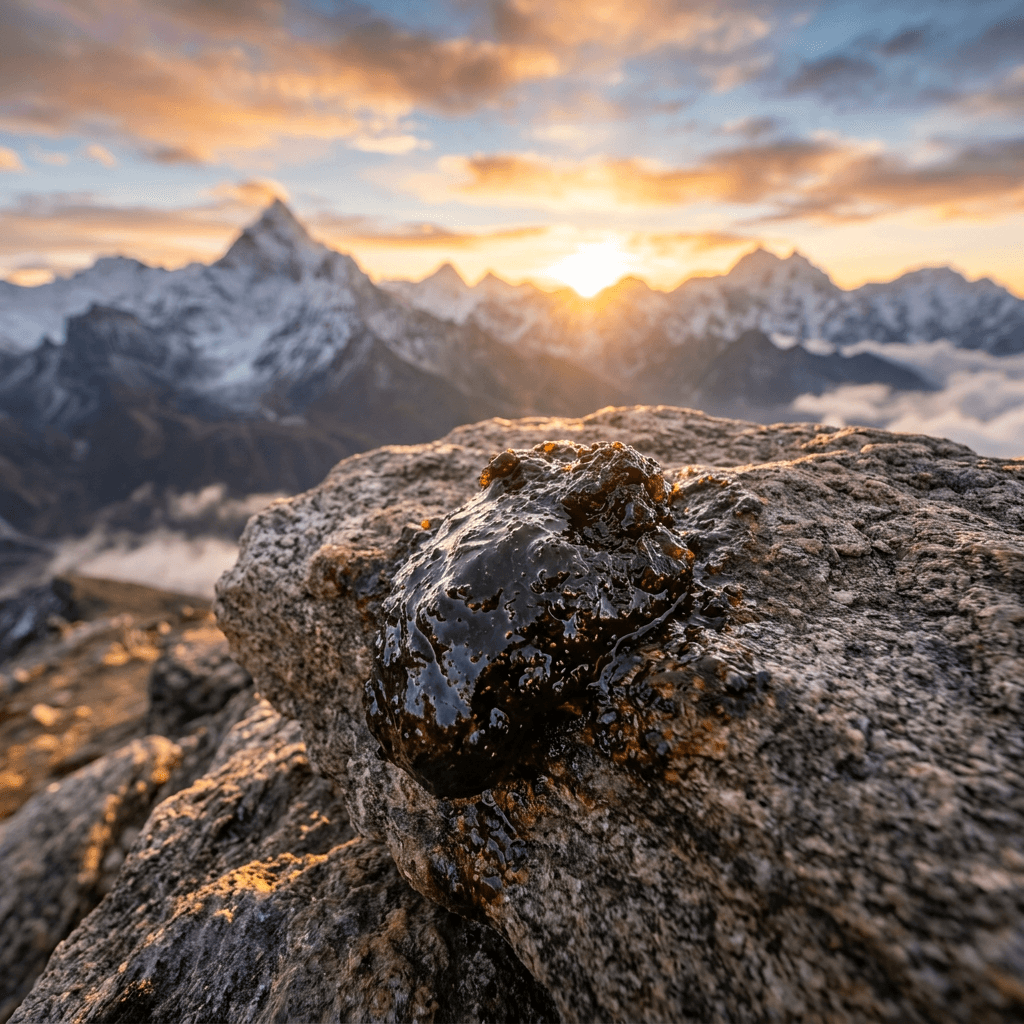
Mad honey is a wild honey that contains small amounts of natural compounds called grayanotoxins. These come from the nectar of certain rhododendron flowers. Ordinary honey has none of them. So this single ingredient is what sets mad honey apart. The grayanotoxins give the honey its reddish colour, its slightly bitter, throat-catching finish, and its mild psychoactive kick. In Nepal it is sometimes called “red honey,” and Himalayan communities have eaten it as both food and medicine for generations.
Grayanotoxins are a family of more than twenty related molecules. But two of them — grayanotoxin I and III — do most of the work. They bind to the sodium channels in your nerve and muscle cells, and hold them open a little longer than usual (see the chemistry here). At a tiny dose, that produces a gentle warming, light-headed effect. At a large dose, the same mechanism slows your heart and drops your blood pressure. That is exactly why dosage matters so much, and we cover safety in detail below.
Importantly, mad honey is not unique to Nepal. A similar honey, known as deli bal, comes from the Black Sea region of Turkey. But the Nepali version is the one with the dramatic backstory — because of where it grows, and who harvests it.

The Giant Bees and the Rhododendron Cliffs
Two things must come together to make genuine Himalayan mad honey: a particular bee and a particular flower. The bee is Apis laboriosa, the Himalayan giant honey bee. It is the largest honey bee on Earth, with workers up to three centimetres long. It nests in the open, building enormous combs under overhangs on vertical cliffs, usually between about 2,500 and 3,000 metres. A single comb can hold up to 60 kilograms of honey. For a long time, scientists treated it as a high-altitude form of the giant honey bee Apis dorsata. But in 2020, researchers confirmed it as a distinct species of its own.
The flower is the rhododendron. Here is where most articles get it wrong, so it is worth being precise. The Turkish honey comes from Rhododendron ponticum and R. luteum. Nepal’s mad honey is different. It comes from native Himalayan species — above all Rhododendron arboreum, known locally as lali gurans and celebrated as Nepal’s national flower. High-altitude species such as R. campanulatum contribute too. Only a handful of Nepal’s thirty-odd rhododendrons carry meaningful grayanotoxin, and the toxin enters the honey only while those plants are in bloom.

Why spring honey is the potent kind
That bloom is why timing is everything. The potent, psychoactive honey is the spring harvest. That is when the high cliffs turn red with rhododendron flowers, and the bees forage on little else. Honey gathered later in the year, from other flowers, is milder and far less active. As a result, true mad honey is seasonal and genuinely limited. That fact should shape your expectations on both price and availability.
Nepal’s Honey Hunters: the Gurung and the Kulung
The honey would be a footnote without the people who gather it. Two communities are best known for the cliff harvest. The Gurung of the central mid-hills — in districts such as Lamjung and Kaski — have hunted these cliffs for generations. So have the Kulung Rai of the Hongu valley in the east, in the region known as Mahakulung. Their methods are broadly similar, and they are genuinely dangerous.
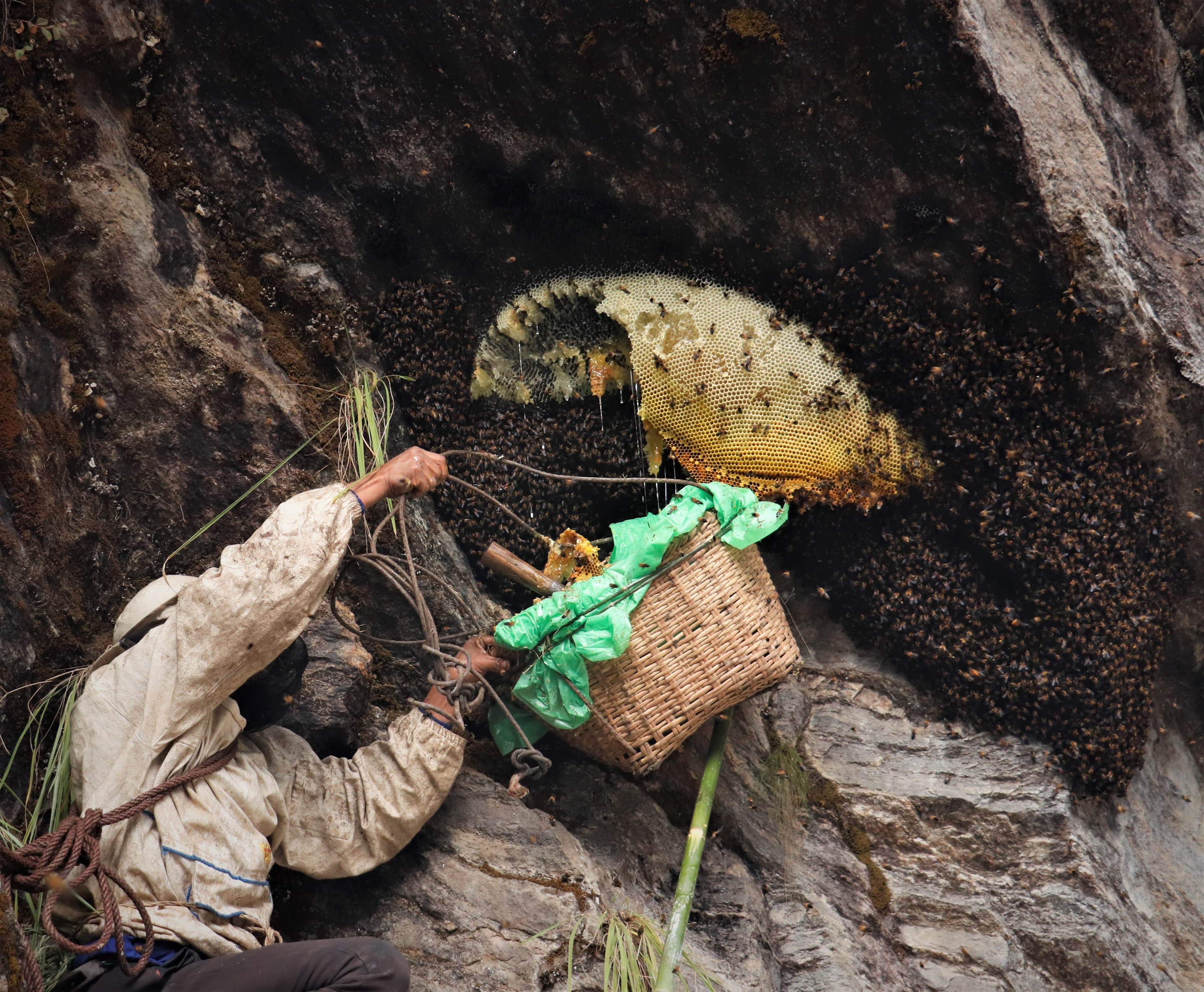
Twice a year, a team lowers a hand-woven bamboo ladder hundreds of feet down a cliff face. Smoke from a fire below drives the bees off the comb. Meanwhile, a hunter hangs on the swaying ladder and works a long pole, called a tango, to cut the comb free and guide it into a basket. A shaman usually performs a ritual beforehand, with offerings to the cliff and forest spirits believed to guard the bees. It is skilled, perilous work — passed down through families rather than taught in any school.
The wider world learned about all this largely through one photographer. In the late 1980s, the French photographer Eric Valli documented the Gurung hunters for National Geographic and the book Honey Hunters of Nepal. His images of a lone figure on a rope ladder, wreathed in smoke and angry bees, became iconic. Decades later, a widely shared VICE video reintroduced the hunt to a new audience. In doing so, it helped spark today’s global demand.

What Mad Honey Does: Effects and Traditional Use
So what does it actually feel like? At a small, traditional dose — think a teaspoon — people describe a warming flush, a mild light-headedness, and a gentle, relaxed tingling. One first-hand account memorably described going “from hot to cold to hot again on the inside,” with a little sweating and dizziness. The effect builds slowly. It usually begins between 20 minutes and a few hours after you eat it. Then it fades over the following day.
In Nepal and across the Himalaya, mad honey has long been a folk remedy rather than a recreational treat. Traditional uses include soothing coughs and sore throats, easing indigestion and gastritis, and acting as a warming tonic in cold, high-altitude winters. It is also taken — especially across the border in Turkey — as an aphrodisiac and a remedy for high blood pressure. But these are traditional uses, not proven cures. The medical evidence is thin. There is also a real irony here: people take it for high blood pressure, yet too much of it sharply lowers blood pressure. So treat it as a cultural specialty with a folk history, not as medicine.
Is Mad Honey Safe? Dosage and Who Should Avoid It
This is the most important section, so let’s be direct. Mad honey is potent precisely because it contains a toxin. The rule is genuinely less is more. The traditional approach is the safe one: take a small amount on a light or empty stomach, and wait. There is no reliable “safe dose”, because the potency swings widely from batch to batch. In fact, poisoning has been reported from as little as a teaspoon of a strong harvest. So treat any amount as a ceiling, not a target, and keep well under a teaspoon. Then wait an hour or two before you even think about more, because the effect is delayed and easy to overshoot.
What too much can do
Take too much, however, and you can tip into what doctors call mad honey poisoning. The hallmark signs are a slowed heart rate and a drop in blood pressure. These often come with nausea, vomiting, heavy sweating, blurred vision, and fainting. The reassuring part is that it is rarely fatal in humans. One review of nearly 1,200 cases recorded no deaths, and most people recover within a day with simple care. The sobering part is that severe cases are real. They can need hospital treatment, and they are turning up more often in the West, as people buy strong honey online without knowing the dose.
Some people should simply not take it. Avoid mad honey altogether if you:
- Are pregnant or breastfeeding
- Take medication for blood pressure or your heart, or have a heart condition
- Are drinking alcohol — never combine the two
- Are elderly, or giving it to a child
A quick note: This article is for general information only and is not medical advice. Mad honey is a traditional specialty food, not a treatment for any condition. Avendi makes no medical claims about it. Start with a very small amount, and never exceed the traditional dose. Speak to a qualified healthcare professional first — especially if you are pregnant, nursing, taking medication, or managing a health condition. If strong symptoms appear after eating it, seek medical help.
Real vs Fake: How to Spot Authentic Mad Honey
Because real cliff honey is rare and expensive, the market is full of fakes. The most common trick is simple. Sellers relabel ordinary golden honey as “red honey.” Or they dilute a little genuine mad honey with cheap honey, until almost nothing active remains. Some even spike honey with additives to fake an effect. So how do you tell? Lead with provenance, then use your senses as a backup.
- Provenance is the strongest signal. A genuine seller can name the harvest region, the season, the bee (Apis laboriosa), and the honey-hunting community. Vague “Himalayan mad honey” with no sourcing is a red flag.
- Colour. Authentic honey is reddish to amber-brown, never the light, clear gold of supermarket honey.
- Taste. Expect a slightly bitter, tannic finish that catches at the back of the throat, with earthy, woody notes — not pure sweetness.
- Effect. Real honey gives a mild warming effect at a small dose. An instant, dramatic high suggests something has been added.
- Price. Authentic cliff honey is seasonal and limited. So a price far below the market rate is a warning sign, not a bargain.
None of these home checks is foolproof on its own, and a determined counterfeiter can pass one or two. So lead with the source. The safest approach is to buy from a seller who states where the honey comes from and stands behind it — exactly the standard we hold our vendors to.
Mad Honey vs Turkish “Deli Bal”
People often confuse the two great mad honeys, so here is the difference. Turkey’s deli bal comes from the Black Sea mountains. Ordinary kept honey bees make it from Rhododendron ponticum, and it is generally milder and more floral. Nepal’s mad honey is different. Wild cliff colonies of the giant Apis laboriosa make it from Himalayan rhododendrons, and it tends to be darker, earthier, and harvested at far greater risk. Both, however, share the same grayanotoxin chemistry — and the same long, colourful history.
That history is genuinely ancient. In 401 BC, the Greek soldier-historian Xenophon recorded a strange episode. His retreating army ate honeycomb near the Black Sea and was promptly laid low — vomiting, disoriented, and unable to stand. All of them recovered within days. Centuries later, according to the geographer Strabo, Pontic forces left toxic honeycombs in the path of Roman troops under Pompey. They then attacked once the honey had done its work. Mad honey, in other words, has been confusing armies for over two thousand years — long before it confused the internet.
Buying Mad Honey on Avendi
Avendi lists authentic Nepali mad honey, fulfilled directly by verified vendors who work with Himalayan honey-hunting communities. What reaches you is the genuine, wild-harvested product — not a diluted or relabelled blend. Every jar ships with its origin and harvest details. Our pricing is set to be fair: a fraction of the inflated rates charged by Western export sites, and in line with honest prices inside Nepal. Here are the options.

Mad Honey 200g – Himaida — NPR 2,550. The everyday jar, and the best place to start. It is enough to try the honey properly, share a little, and keep some for winter. It also ships with its sourcing documented. A sensible first purchase if you are new to it.

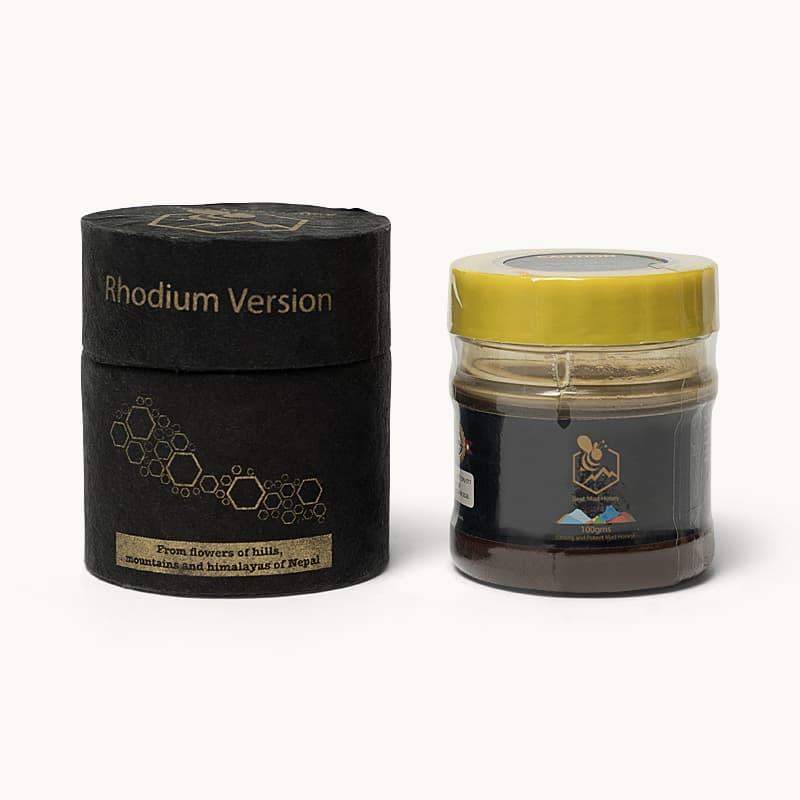
Mad Honey 100g – Rhodium — NPR 4,500. The premium, small-batch option, selected for a stronger, cleaner profile. Choose this if you want the highest grade in a compact jar. It also makes a striking, story-rich gift from Nepal.
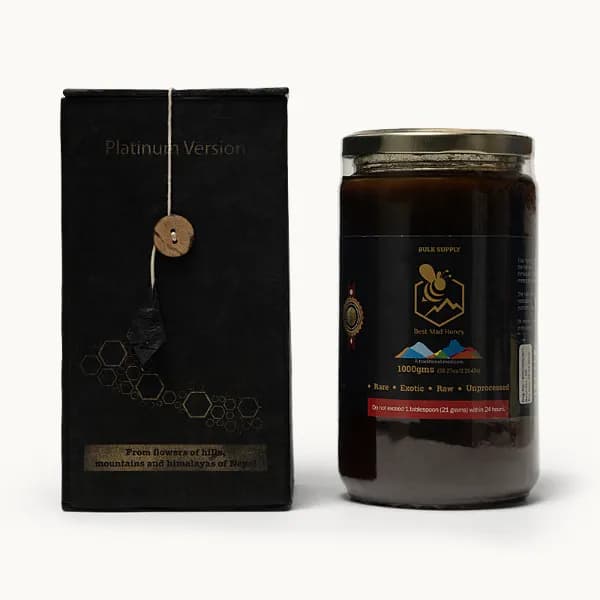
And for regulars, the Mad Honey 1kg – Himaida — NPR 8,000 — is the family-size, best-value jar. It is the same wild honey, in bulk.
Real Himalayan mad honey, harvested in Nepal and shipped with its origin documented.
Frequently Asked Questions
What is mad honey?
Mad honey is a rare wild honey that contains natural grayanotoxins from rhododendron nectar. In Nepal, giant Himalayan cliff bees make it. It has a reddish colour, a slightly bitter taste, and a mild warming effect at a small dose. Ordinary honey contains no grayanotoxins — and that is what makes mad honey different.
What does mad honey taste like?
It tastes less sweet than normal honey. Expect a distinct bitter, slightly tannic finish that catches at the back of the throat. The colour is reddish to amber-brown, and the aroma is floral but earthy. If a “mad honey” is light gold and purely sweet, it is almost certainly fake or heavily diluted.
How does mad honey work?
The grayanotoxins bind briefly to the sodium channels in your nerve and muscle cells, and slow how they reset. At a small dose, this creates a warming, mildly relaxing, light-headed effect. At a large dose, the same action slows the heart and lowers blood pressure. That is why the dose matters so much.
How much mad honey should I take?
There is no reliable safe dose, because the potency varies a lot between batches. Poisoning has been reported from as little as a teaspoon of a strong harvest. So if you try it, start with a tiny amount, well under a teaspoon, on a light or empty stomach. Then wait at least an hour before considering any more, because the effect is delayed. Never take it with alcohol. And avoid it entirely if you are pregnant or on heart or blood-pressure medication.
What happens if you take too much?
Too much mad honey can cause grayanotoxin poisoning. The main signs are a slow heart rate and low blood pressure, often with nausea, vomiting, sweating, dizziness, and fainting. It is rarely fatal — a review of nearly 1,200 cases found no deaths — and most people recover within a day with care. Even so, severe cases need treatment. Respect the dose, and seek help if strong symptoms appear.
Does mad honey lower blood pressure?
Yes. Grayanotoxin stimulates the vagus nerve, which slows the heart and lowers blood pressure. So that is a core reason large doses are dangerous — not a reason to use mad honey as a remedy. Therefore, if you have low blood pressure, a heart condition, or take blood-pressure or heart medication such as beta-blockers, avoid it, because the effects stack. Its traditional use as a blood-pressure cure has no clinical evidence behind it.
How long do the effects last?
Effects usually begin between 20 minutes and a few hours after eating it. Then they ease off over the rest of the day. Because the onset is slow, people often take more too soon. So patience is part of using it safely.
Is mad honey legal in the US?
In the United States, mad honey is legal in all 50 states. It is not a controlled substance, and grayanotoxin is not scheduled by the DEA. Instead, the FDA regulates it as a food, so you can buy and import it for personal use. However, a seller who makes medical claims turns it, legally, into an “unapproved drug”. It is likewise a legal but food-regulated product in the UK and across much of the EU. Some authorities restrict or flag grayanotoxin honey, and a few countries — South Korea, for example — ban it. If you are importing it, check your local food rules first.
How much does mad honey cost?
Genuine Himalayan mad honey is seasonal and limited, so it is never cheap. Western export sites often charge USD 26 to 150 or more for a small jar. On Avendi, by contrast, Nepali mad honey is priced fairly — from NPR 2,550 for a 200g everyday jar, up to NPR 8,000 for a 1kg jar. So a price far below the going rate is a warning sign, not a bargain. Usually it means the honey is diluted or fake.
How is Nepali mad honey different from Turkish deli bal?
Both contain grayanotoxins, but they come from different bees and plants. Turkish deli bal is made by ordinary kept bees on Rhododendron ponticum, and tends to be milder and more floral. Nepali mad honey is made by wild giant cliff bees on Himalayan species such as Rhododendron arboreum. It is usually darker, earthier, and harvested at much greater risk.
Which rhododendron does Nepali mad honey come from?
Chiefly Rhododendron arboreum — lali gurans, Nepal’s national flower — along with high-altitude species such as R. campanulatum. The R. ponticum and R. luteum you often see quoted are the Turkish sources, not the Nepali ones. Only a few rhododendron species carry enough grayanotoxin to matter. And the honey is potent only when those plants are in spring bloom.
Is mad honey harvesting sustainable?
Not always, and that is a real concern. Apis laboriosa, the giant cliff bee, has declined sharply in Nepal — experts estimate its numbers have fallen by more than half in recent decades. Habitat loss and a warming climate both play a part. But online demand is now the sharp new threat, because it pushes hunters to harvest combs too early and too often. So it matters where you buy. Responsible sellers work with honey-hunting communities that harvest on the traditional seasonal calendar and leave combs to recover.
Is mad honey a good gift?
Yes — it is one of the most distinctive things you can bring back from Nepal. A jar is easy to pack, it keeps well, and it carries a remarkable story of cliff hunters and giant bees. The premium 100g jar makes an especially memorable gift. Just pair it with a quick note on sensible dosing for anyone who has never tried it.
How can I be sure the mad honey is real?
Buy on provenance. A trustworthy seller can tell you the harvest region, the season, and the honey-hunting community. The honey itself should be reddish, slightly bitter, and only mildly warming at a small dose. Suspiciously cheap, light-gold, purely sweet honey with no stated origin is the classic fake. Avendi sources only from verified Nepali vendors, and ships each jar with its origin and harvest details.
The Bottom Line
Mad honey is one of the Himalaya’s genuine wonders. It is a wild, faintly dangerous honey, gathered at real risk by hunters who have done it for generations. It deserves to be understood rather than hyped. So take it seriously, start with a tiny amount, and buy the real thing from a source that can tell you where it came from. Do that, and a jar of Nepali mad honey is a remarkable taste of the mountains. If you enjoy discovering Nepal’s specialties, read our guide to authentic Himalayan shilajit next. Or browse the wider guide to what to buy in Kathmandu.
Image credits: Gurung honey hunter — Kandelrashmi (CC BY-SA 4.0). Rhododendron arboreum — The Nilgiris Raju L (CC BY-SA 4.0). Apis laboriosa — Smkbhatt (CC BY-SA 4.0), all via Wikimedia Commons. Product images courtesy of the vendors / Avendi.