Mithila Art: The Complete Guide to Nepal’s Madhubani Painting Tradition
Shop this story on Avendi
See all →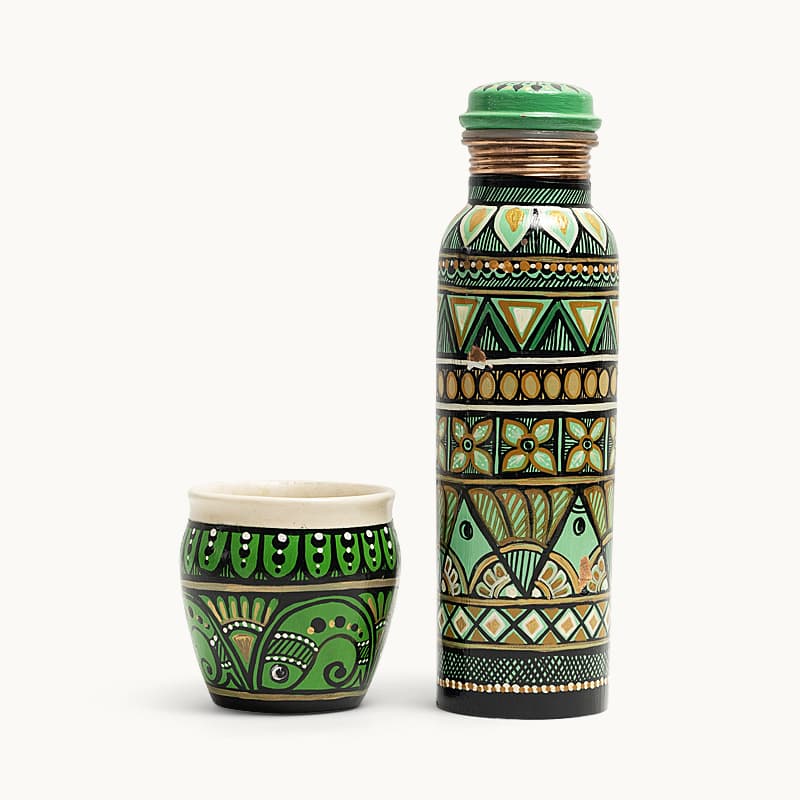
In the old towns of the Mithila plains, women have painted their walls for as long as anyone can remember. They mark a wedding, a harvest, or the birth of a child with fish, lotuses, and gods drawn in bright natural colour. This living folk tradition is Mithila art, and it belongs to a single cultural region that spans southern Nepal and northern India.
You will also hear it called Madhubani painting. The two names describe one art form. This guide explains where it comes from, how to read its symbols, how it is made, and how to tell a genuine hand-painted piece from a cheap print — so you can buy with confidence and know exactly what you are looking at.
What is Mithila art (also called Madhubani painting)?
Mithila art is a folk-painting tradition from the Mithila region, the cultural area that covers Nepal’s Janakpur plains and India’s northern Bihar. Maithil women created it, and for centuries they painted it freehand on the mud walls and floors of their homes. Today the same visual language appears on handmade paper, cloth, ceramics, and even leather, yet the style stays instantly recognisable.
So why the two names? “Mithila” is the name of the region, and it is the term most people use in Nepal. “Madhubani” is a district in Bihar where the art is especially concentrated, and it became the popular name in India after the work reached the wider market. Therefore Mithila art and Madhubani painting are the same tradition, simply labelled from two sides of one border.
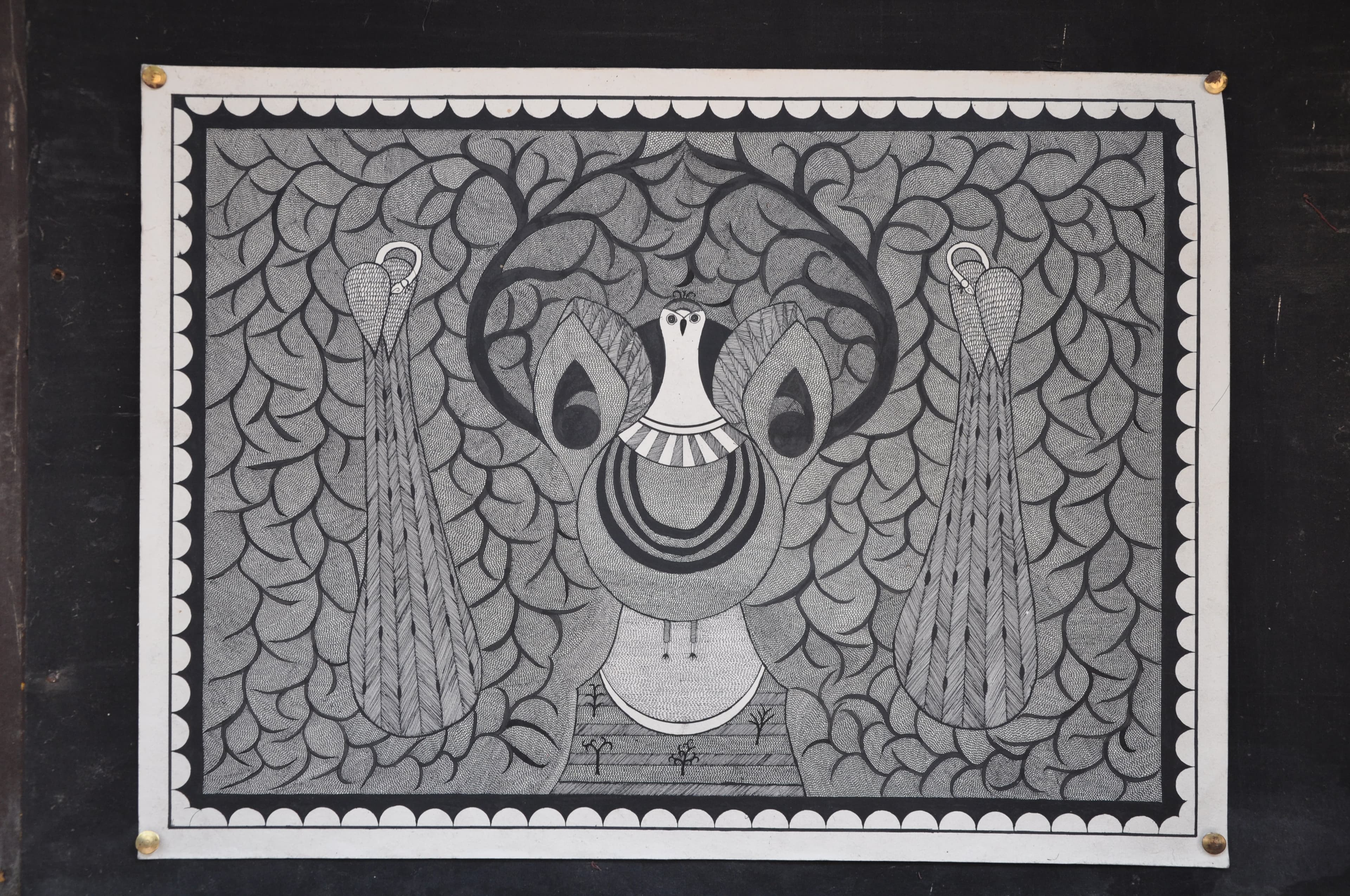
You can spot the style at a glance. Figures stay flat and face you head-on, with large almond eyes that almost fill the face. Bold borders frame every scene. Above all, the artist leaves no space empty: she packs every gap with flowers, birds, fish, or geometric pattern, because tradition treats bare space as unlucky. That density is exactly why a finished piece feels so alive.

From Janakpur’s walls to the world: a short history
By tradition, the story begins with a wedding. Local legend traces Mithila art to King Janak of Mithila. He reportedly commissioned paintings to celebrate the marriage of his daughter Sita to Lord Rama in the Ramayana. Today, people still honour Janakpur, in southern Nepal, as Sita’s birthplace. So the art and the epic belong together from the very start.
For most of its history, though, the tradition stayed strictly domestic. Women prepared a wall with a wash of cow dung and clay, then painted it for festivals such as Chhath and Diwali, for weddings, and for births. They rarely signed the work, and they never expected it to last. The next festival simply brought a fresh layer. Meanwhile, mothers passed the motifs to daughters, so the knowledge moved quietly down the generations.
Discovery, drought and the move to paper
The outside world only noticed by accident. After the great Bihar earthquake of 1934, the British colonial officer William G. Archer spotted the painted interior walls of collapsed houses and began to document them. Decades later, drought changed everything again. During the 1966–67 famine, India’s All India Handicrafts Board sent the artist Bhaskar Kulkarni to encourage Maithil women to paint on paper, so they could sell the work for income. That single shift — from wall to paper — turned a private ritual into an art form the world could collect.
Recognition followed steadily. In 2007 the name “Madhubani painting” received a Geographical Indication (GI) tag in India, which protects it from imitation by non-Mithila producers. Several artists have since won the Padma Shri, and the tradition now supports tens of thousands of painters across the region.
Here is the journey at a glance:
- Ancient roots — women paint walls and floors for weddings and festivals, tied to the Sita legend.
- 1934 — the Bihar earthquake exposes painted interiors, and William Archer begins to document them.
- 1966–67 — drought pushes the art onto paper for sale, with help from Bhaskar Kulkarni.
- 1981 — Sita Devi receives the Padma Shri, and international recognition grows.
- 1989 — the Janakpur Women’s Development Center carries the paper tradition into Nepal.
- 2007 — “Madhubani painting” earns its GI tag in India.

Janakpur and the women artists of Nepal
Most writing about this art focuses on the Indian side. Yet Nepal holds the spiritual heart of Mithila. Janakpur, home of the Janaki Mandir temple, is where the Sita story lives most strongly, and the villages around it have painted in this style for generations. In fact, when the 1816 Treaty of Sugauli divided the old kingdom of Mithila, Nepal kept about a quarter of it, including Janakpur. So the Nepali tradition keeps its own character, often a little softer in palette and closely tied to ritual life.
The turning point in Nepal came in 1989. That year, the American artist-researcher Claire Burkert and a group of twelve local women turned the wall-painting heritage into a livelihood, and they registered it as the Janakpur Women’s Development Center in 1992. Crucially, they chose to paint on Nepal’s own handmade lokta paper, using brushes and colour rather than the sticks and mineral pigment of the walls. As a result, the centre gave them a steady income, and it carried a domestic craft into a wider market without stripping away its meaning.
That detail matters, because this is overwhelmingly a women’s art. The famous names of the tradition are women. Sita Devi of Jitwarpur became the first internationally celebrated Madhubani painter and won the Padma Shri in 1981. Ganga Devi earned hers in 1984. When you buy a genuine piece today, you are taking part in the same story: a woman painting, and earning, from a skill her mother taught her.

The five styles of Mithila painting
Scholars usually group the tradition into five styles. They began with different communities, and for a long time they followed caste lines. Over time, however, the art opened up, and today artists move freely between them. Here is how to tell them apart.
- Bharni — the “filled” style. Bold outlines are flooded with solid, vivid colour, and the subjects are usually gods and mythology. It is the look most people picture first.
- Kachni — the “line” style. Fine hatching and delicate line work carry the image, often with little or no colour. The result is quiet and intricate.
- Tantrik — the esoteric style. It draws on tantric imagery, the Mahavidya goddesses, and ritual symbols, blending geometry with figures.
- Godna — the “tattoo” style. Inspired by traditional tattoo patterns, it uses repeated geometric forms. It grew from the Dusadh community and helped open the art beyond its original castes.
- Kohbar — the marriage style. These are the paintings made for a newlywed couple’s chamber, rich with fertility symbols such as the lotus and bamboo.
Knowing the five styles changes how you look at a piece. A dense, colour-saturated panel of deities is Bharni. A fine black-line study is Kachni. Once you can name the style, you can also judge the skill behind it.
Reading the symbols: what Mithila motifs mean
The real depth of this art lies in its symbols. Almost nothing is decorative for its own sake. Instead, each motif carries a wish, usually for fertility, prosperity, or protection. So a painting also works as a blessing, which is why people often give these pieces as wedding and housewarming gifts.
- Fish — the most beloved motif of all. Drawn in pairs or shoals, fish stand for fertility, abundance, and good luck, and they appear constantly on wedding gifts.
- Peacock — love and marital devotion, a favourite for romantic and bridal scenes.
- Lotus — purity, rebirth, and female fertility; the central flower of many kohbar paintings.
- Sun and moon — often drawn as faces, they represent life, energy, and cosmic balance.
- Elephant and tortoise — strength, stability, and auspicious blessing.
- Bamboo — the family line and continuity, traditionally a male symbol paired with the lotus.
- Tree of life and parrots — the link between earth and heaven, plus love and fidelity.
The kohbar: a painting that blesses a marriage
The most loaded image of all is the kohbar. Artists paint it on the wall of a newlywed couple’s room, and it brings the symbols together into one composition: a ring of lotus blossoms around a central stalk, often with bamboo, fish, birds, and the sun and moon. Together, these stand for union, fertility, and a long shared life. In short, a kohbar is less a picture than a blessing for the marriage itself.
Gods appear everywhere too. Krishna and Radha, Ram and Sita, Durga, Saraswati, and Ganesha all feature, each tied to a season or a ritual. Because the symbols are shared, a Maithil viewer can “read” a painting much as you would read a sentence. That is the part worth learning, not just looking at.
How Mithila art is made
Traditional pieces use natural colour rather than commercial paint. For example, red comes from the kusum flower or sandalwood, and yellow comes from turmeric. Soot makes black, indigo makes blue, and leaves make green. Artists then bind these pigments and apply them with simple tools: a twig, a matchstick, cotton wrapped around a bamboo stick, and sometimes just a finger.
The technique splits along the same lines as the styles. In Bharni work, the artist first draws a double outline and then fills it with colour. In Kachni work, however, fine repeated lines do all the shading. Either way, tiny geometric units build the borders, and the artist fills every gap. Because each woman paints freehand, no two pieces ever look identical.
What has changed is the surface. The art moved from walls to lokta paper, then to cloth and canvas, and now to everyday objects. Today you will find the same motifs on cups, trays, bottles, and bags. The medium keeps modernising, yet the vocabulary stays exactly the same.

Authentic vs mass-produced: how to spot the real thing
As the art grew popular, cheap printed imitations followed. Knowing the difference protects both your money and the artists. Fortunately, a genuine hand-painted piece gives itself away once you know what to look for.
- Look for small irregularities. Hand-drawn lines wobble slightly and vary in thickness. Printed designs repeat with machine perfection.
- Check the colour. Natural and hand-applied colour sits unevenly and has depth. A flat, glossy, perfectly even finish often signals a print.
- Turn it over. On paper and cloth, hand painting often shows faint bleed or texture on the back. A clean printed reverse is a warning sign.
- Ask about the source. A real piece can usually be traced to a named artist, a village, or a cooperative. If no one can tell you who made it, be cautious.
The safest route is simply to buy direct from artists, cooperatives, or sellers who name their source. You will pay a fair price, and far more of that price reaches the woman who actually painted the piece.
Caring for Mithila art and handicrafts
These pieces are durable, but they are still artisanal, so treat them gently. For paintings on paper or cloth, keep them out of direct sunlight, because strong light slowly fades natural pigment. Frame valuable works under glass, and avoid damp walls, since humidity is the main enemy of handmade paper.
For painted homeware such as cups, bottles, and trays, hand-wash with mild soap and a soft cloth. Skip the dishwasher, and never scrub the painted surface. With that small amount of care, a hand-painted object lasts for years and keeps its colour.
Mithila art on Avendi
Avendi lists Mithila-art homeware from Dhuku: A Handmade Collective, a Nepali, women-led concept store. The name “Dhuku” comes from the Newari word for a community treasury, and the idea fits the work: local women artisans painting everyday objects by hand, then earning directly from what they make. Every piece below is hand-painted, so each one is a little different.
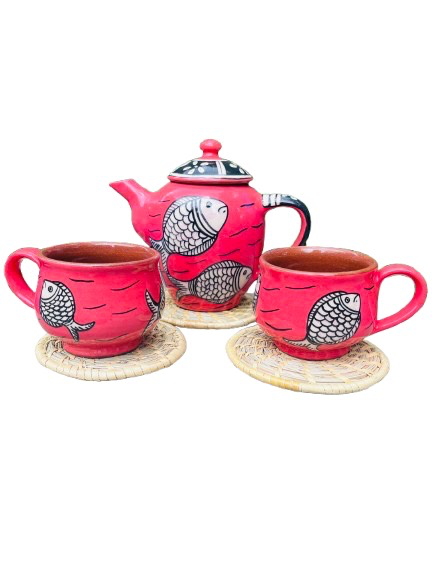
Drinkware
The easiest way to start is something you will use daily. For example, the Mithila Art Mug (NPR 950) and the Mithila Cup Set (NPR 2,100) bring the motifs to your tea table. In addition, the cup set also comes in pink and sunflower designs (NPR 2,200 each).

Bottles and gift sets
For a statement piece or a wedding gift, the bottles carry the most detail. You can choose the hand-painted copper bottle (NPR 3,500) or the 1L bottle (NPR 4,000). Meanwhile, the matching sets make the strongest gifts: the Bottle & Cup Set and the Bottle & Mug Set in dark or light finishes (NPR 4,700 each).

Home and everyday
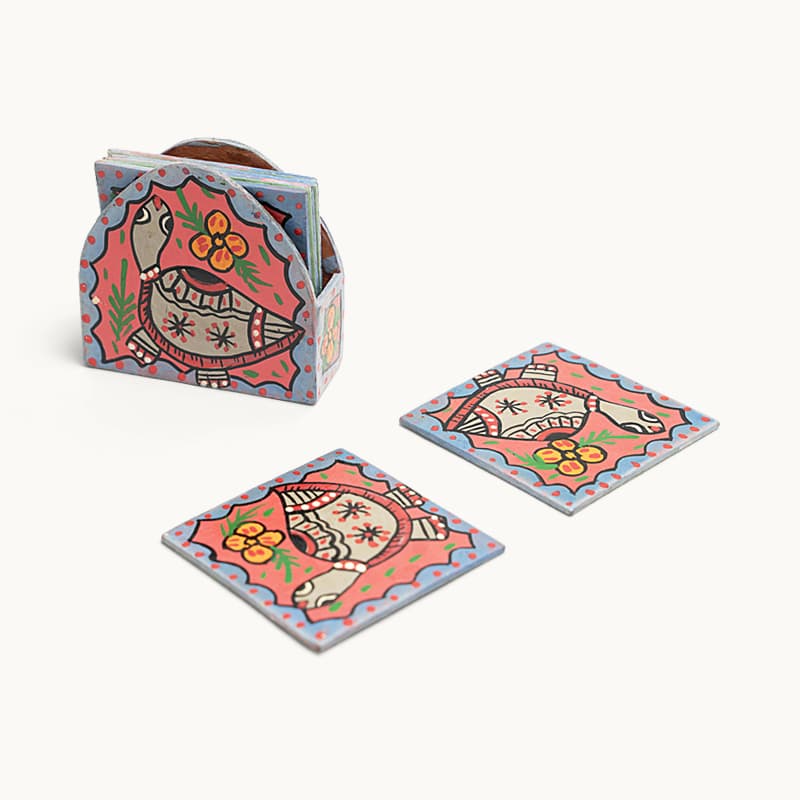
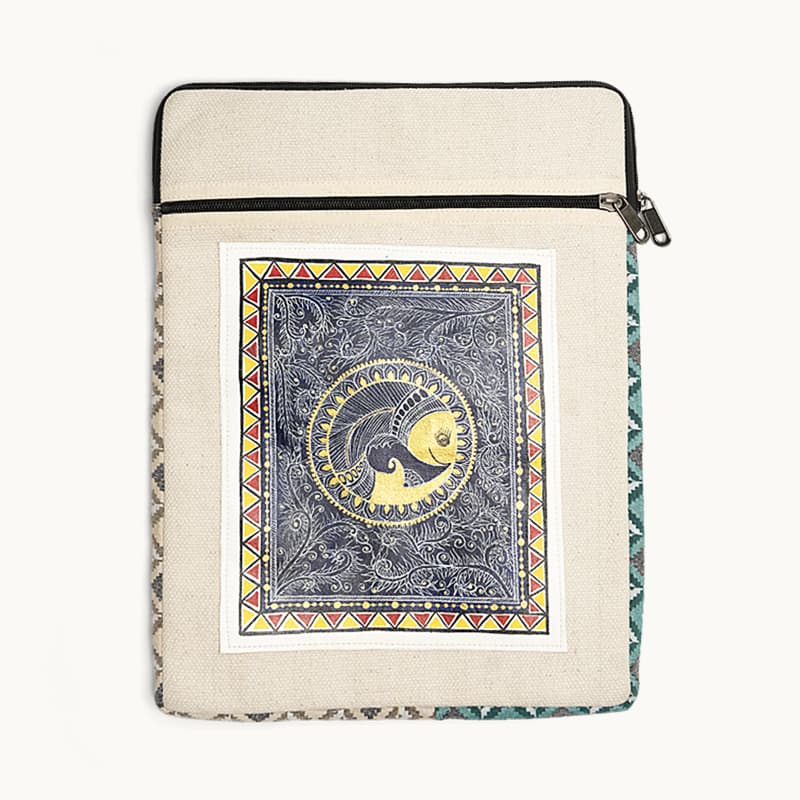
Finally, smaller pieces work beautifully as gifts. The Mithila Art Coaster Set of six (NPR 950) is a popular starter, and the Mithila Laptop Bag (NPR 2,500) carries the tradition to your desk.
Frequently asked questions
Is Mithila art the same as Madhubani painting?
Yes. They are two names for one tradition. “Mithila” is the cultural region that crosses southern Nepal and northern India, and it is the common name in Nepal. “Madhubani” is a district in Bihar, and it became the popular name in India. The style, symbols, and technique are the same.
Where does Mithila art come from, Nepal or India?
Both. The Mithila region straddles the border, so the art is genuinely shared. Janakpur in Nepal is its spiritual heart and Sita’s birthplace, while the Madhubani district in India is its best-known centre. Neither side “owns” it; it is one tradition with two homes.
Why is the fish so common in Madhubani art?
The fish is a symbol of fertility, abundance, and good luck. Artists often draw it in pairs or shoals, especially on pieces meant as wedding gifts. Because the wish is so positive, the fish became one of the most repeated motifs in the whole tradition.
What are the five styles of Madhubani painting?
The five styles are Bharni, Kachni, Tantrik, Godna, and Kohbar. Bharni fills bold outlines with colour. Kachni relies on fine line work. Tantrik uses ritual and goddess imagery. Godna borrows from tattoo patterns. Kohbar is painted for weddings. Artists today often combine them.
What is special about Madhubani painting?
Two things set it apart. First, it is a living tradition still painted by the community that created it, mostly by women, often by hand on everyday objects. Second, almost every motif means something, so each painting doubles as a blessing. You are buying a wish, not just a decoration.
What is a kohbar painting?
A kohbar is the painting made for a newlywed couple’s room. It gathers fertility symbols — a ring of lotuses, bamboo, fish, and the sun and moon — into one composition that wishes the marriage union and long life. It is among the most meaningful forms in the whole tradition.
What colours and materials are used?
Traditional work uses natural pigment: turmeric for yellow, kusum flower or sandalwood for red, soot for black, and indigo for blue. Artists apply it with twigs, matchsticks, bamboo pens, and fingers. Modern pieces on paper or objects sometimes use acrylic for durability, but the look stays the same.
How can I tell authentic Mithila art from a print?
Look closely at the lines. Hand painting wobbles slightly and varies in thickness, while prints repeat perfectly. Natural colour also sits unevenly and has depth. Finally, ask who made it. A genuine piece can usually be traced to an artist, a village, or a cooperative.
Who are the most famous Madhubani artists?
Sita Devi of Jitwarpur was the first internationally recognised painter and received the Padma Shri in 1981. Ganga Devi won hers in 1984. Other celebrated names include Mahasundari Devi, Baua Devi, and Dulari Devi. Almost all of the tradition’s masters are women.
Is Mithila art still made today?
Very much so. Thousands of artists still paint across the Mithila region, and cooperatives in both Nepal and India keep the tradition working. The art has simply expanded its surfaces, moving from walls to paper and now to cups, bottles, bags, and trays, so the same motifs reach new homes every year.
How do I care for a Mithila painting?
Keep paintings out of direct sunlight and away from damp, because both fade and damage natural pigment. Frame paper works under glass. For painted cups and bottles, hand-wash gently with mild soap, skip the dishwasher, and never scrub the design.
Is Mithila art a good gift?
It is one of the best. Every motif carries a blessing, so the gift means something. A fish design wishes prosperity, a peacock wishes love, and a lotus wishes new beginnings. That built-in meaning makes it ideal for weddings, housewarmings, and special occasions.
The bottom line
Mithila art is one of the few folk traditions still painted by the people who created it. When you choose a genuine piece, you support a living craft and the women who keep it alive, and you bring home a real blessing rather than a printed copy. Learn the symbols, check that the work is hand-painted, and buy from a source that names its makers. If you enjoy discovering Nepal’s specialties, browse our guide to the best things to buy in Kathmandu next.
Image credits: Madhubani painting by Mohitkiran (CC BY-SA 3.0); “Sita Ram Swayamvar” by Janakpur Art (CC BY-SA 4.0); Mithila artist at work by Pallav.journo (CC BY-SA 4.0); Madhubani-painted bottle by Imakanksha (CC BY-SA 4.0) — all via Wikimedia Commons. Product images courtesy of Dhuku: A Handmade Collective / Avendi.