What to Buy in Kathmandu: 15 Best Souvenirs and Handicrafts
Shop this story on Avendi
See all →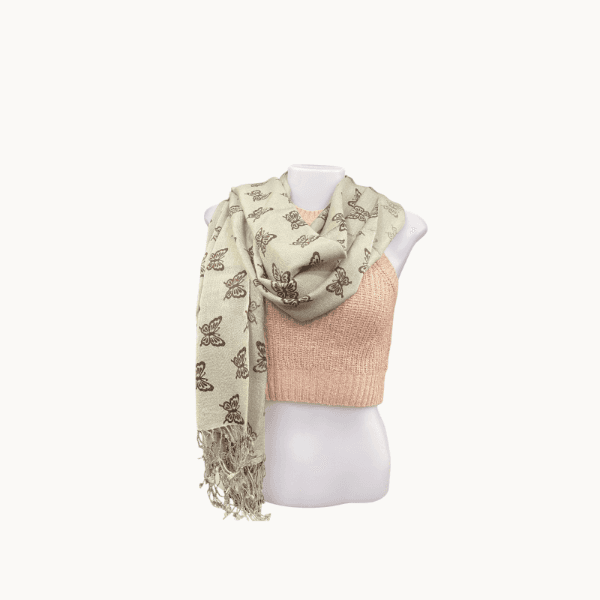
Kathmandu is a living museum, and that history spills straight onto its shop shelves. Wander from the incense-filled lanes of Thamel to the temple courtyards of Patan and Bhaktapur. Along the way you pass shawl weavers, metal-beaters, paper-makers, and thangka painters working much as their grandparents did. So when it is time to pack, one question always comes up: out of all this colour and craft, what should you actually take home? If you are searching for what to buy in Kathmandu, you have come to the right place.
This guide covers the 15 best souvenirs and handicrafts from Nepal’s capital — the Nepali handicrafts, textiles, and edible gifts worth space in your suitcase. For each one, you will learn what it actually is, how to tell the real thing from a tourist knock-off, and exactly where to buy it. Some are world-famous, like pashmina and the khukuri. Others, like lokta paper and allo-fibre bags, fly under the radar but make wonderful, lightweight gifts.
One quick note before the list. You do not have to trek across the city to find authentic pieces. Avendi Local carries many of these exact Nepali crafts at the maker’s own price and delivers them the same day to wherever you are staying. And if you would rather shop in person, the practical tips near the end cover bargaining, authenticity, and the export rules you genuinely need to know.
🛍️ In Kathmandu right now?
Most of the souvenirs below come from local Nepali makers and artisan cooperatives — Avendi delivers them from the maker to your hotel, same day, at the maker’s own price.

Nepal’s Signature Textiles and Wearables
When you are working out what to buy in Kathmandu, start with textiles: Nepal’s fabrics are the easiest souvenirs to pack and among the most distinctive. Each one carries a regional story, so here is how to choose well.
1. Authentic Pashmina and Cashmere
Pashmina is the souvenir most travellers come for, and for good reason. It is the ultra-fine cashmere combed from the Chyangra, the Himalayan mountain goat (Capra hircus) that grows a downy under-fleece to survive high-altitude winters. The word itself comes from the Persian pashm, meaning wool. The finest fibres measure only 12 to 16 microns across — far thinner than a human hair. As a result, a genuine shawl feels weightless yet astonishingly warm.
Here is the catch, however. “Pashmina” is not a legally protected fibre name, so a great deal of what is sold under that label is actually viscose, sheep wool, or a synthetic blend. To cut through the confusion, Nepal created the Chyangra Pashmina trademark, run by the Nepal Pashmina Industries Association. It is a collective trademark rather than a geographical indication. It still guarantees real standards: at least 97% pashmina purity, a fibre diameter of 17 microns or finer, and AZO-free dyes. Therefore the single most reliable move is to look for that official trademark. Then buy from association members or established Patan cooperatives.

How to Spot a Real Pashmina
Folk tests are less helpful than the internet suggests. The famous “ring test” — sliding a shawl through a wedding ring — only proves the cloth is thin, not that it is real cashmere. Fine synthetics slip through too, after all. Likewise, a burn test can rule a synthetic out (plastic smells acrid and melts, while natural protein fibres smell of singed hair), yet it cannot tell pashmina from ordinary wool. So treat suspiciously cheap “pashmina” as a blend. Always read the stated fibre content rather than the word on the tag.
For genuine pieces, look to Nepali pashmina and cashmere from local mills — including a hand-woven cashmere scarf (NPR 10,500) and the lighter Butterfly Bloom printed pashmina shawl (NPR 5,500) — delivered to your hotel the same day.
2. Dhaka Fabric and the Dhaka Topi
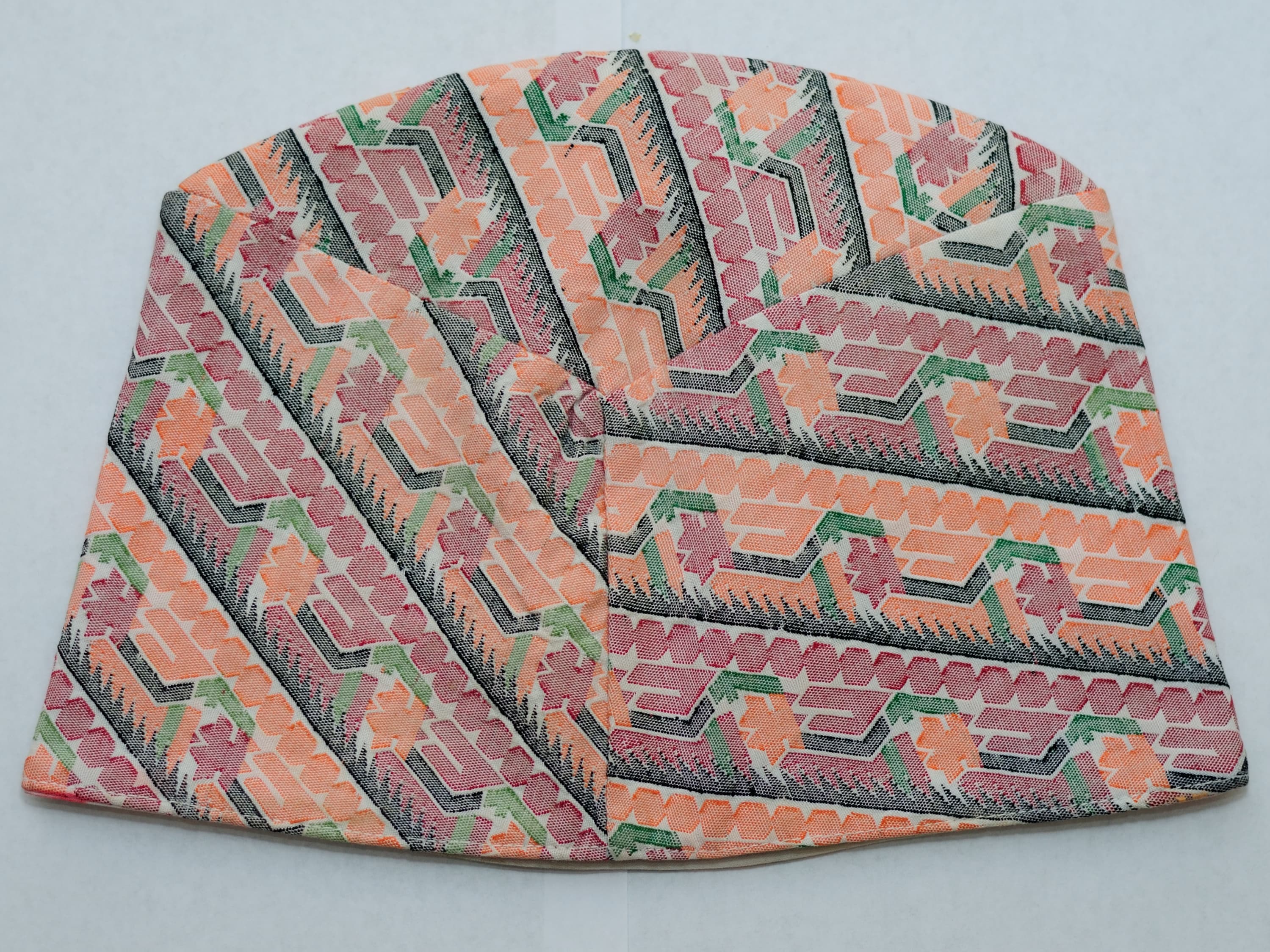
Dhaka is Nepal’s vivid handwoven cloth, instantly recognisable from its geometric diamonds and zig-zags in clashing colours. Contrary to a common claim, it is not a reversible double-weave. Instead, weavers use a supplementary-weft inlay technique, laying an extra patterning thread into a plain ground weave, which is why you see loose floating threads on the reverse. The best hand-loomed Dhaka comes from Terhathum and Palpa (Tansen) in the eastern and western hills, much of it woven by Limbu women.

The cloth’s most famous form is the Dhaka topi, the brimless cap that is part of Nepal’s national dress. King Mahendra popularised it in the mid-20th century. He even made it mandatory for passport and official document photos, which cemented its place as a national symbol. Consequently, a topi makes a meaningful gift, while Dhaka ties, purses, and scarves travel more easily in a suitcase. The name probably nods to yarn once imported from Dhaka in present-day Bangladesh, though historians treat that origin as uncertain.
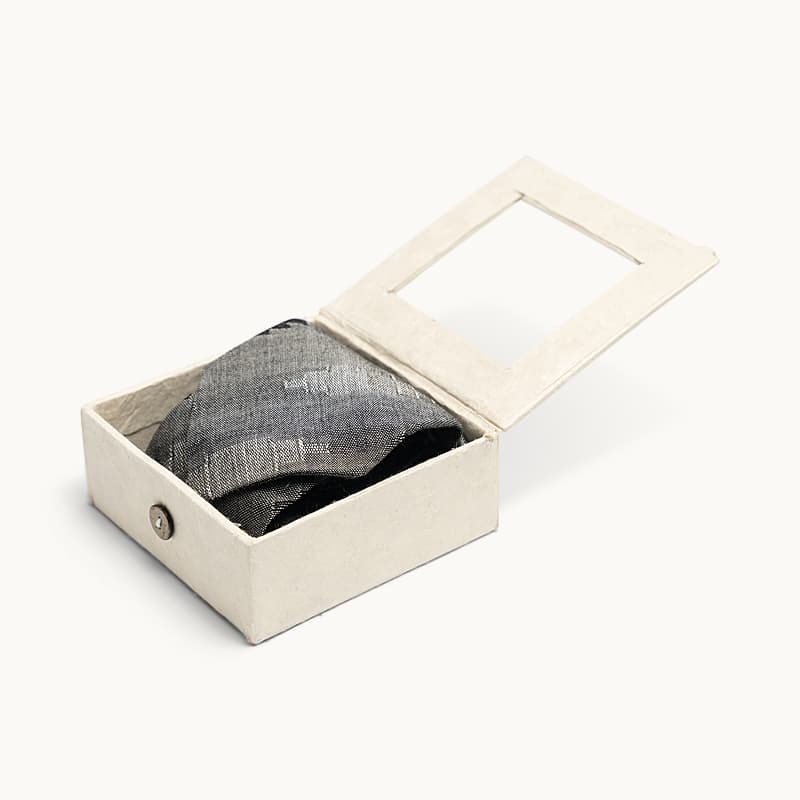
Handwoven Dhaka fabric pieces by the Dhuku handmade collective — such as a Dhaka tie (NPR 2,200) or a handy Dhaka purse (NPR 2,200) — woven from authentic Dhaka cloth. For the full story, read our guide to the Dhaka topi and Dhaka fabric.
3. Allo and Hemp Bags
For an eco-friendly gift with real Himalayan roots, look for allo. People often call these “hemp” bags, but the two plants are different. Allo is the Himalayan giant nettle (Girardinia diversifolia). Its bast fibre is stripped, boiled with wood ash, and then hand-spun into a strong, lightly lustrous yarn by communities such as the Gurung, Rai, and Magar. True hemp comes from Cannabis sativa instead. Many “hemp” products on sale are in fact allo, or a blend, so it is worth asking what the fibre really is.
A word on the legal grey area, because travellers ask. Hemp cultivation has been banned in Nepal since 1976, yet finished hemp and allo goods are openly made and sold, with fibre largely wild-harvested in the western hills. So the bags themselves are widely available and tolerated; the plant’s cultivation is the part that remains illegal. Either way, allo is the more sustainable, more distinctly Nepali choice — and a rugged tote outlasts almost any other souvenir.
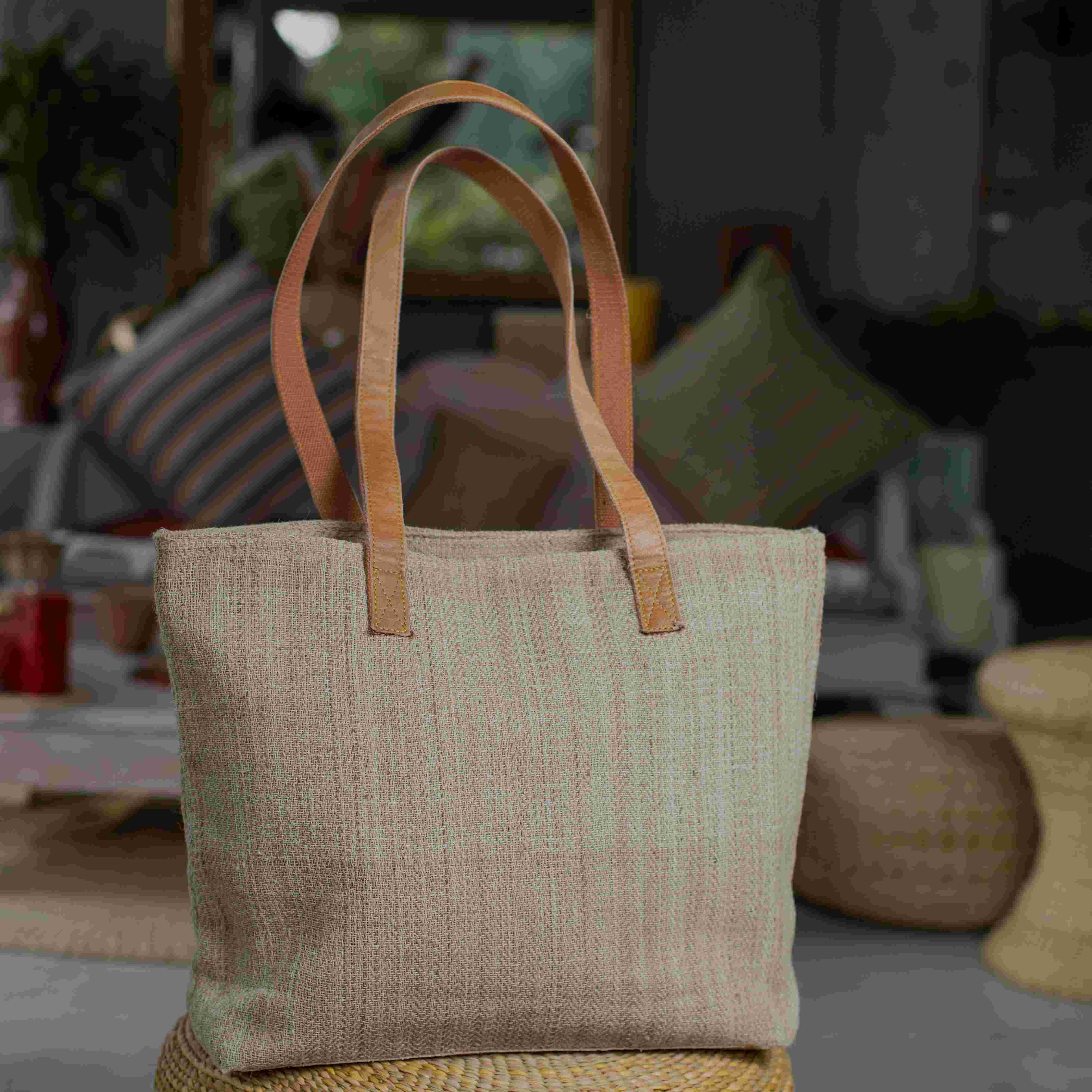
Carry your finds in an Allo bag with leather handles (NPR 6,500) or pick up a slim allo-fibre wallet (NPR 750) — both handcrafted from Himalayan nettle.
Sacred Art and Spiritual Keepsakes
Kathmandu Valley is one of Asia’s great centres of religious art. These three keepsakes carry deep meaning, so a little knowledge helps you buy with respect — and avoid a fake.
4. Thangka and Paubha Paintings
A thangka is a Buddhist scroll painting of a deity, mandala, or sacred scene, mounted on cloth so it can be rolled up. The word itself means “thing one unrolls.” Here is the Nepali twist that many sellers skip, though. The Kathmandu Valley has its own older, indigenous tradition called paubha, painted by the Newar Chitrakar caste and covering both Hindu and Buddhist subjects. Newar artists carried this art to Tibet, where the thangka later evolved from it — so the form you are admiring has deep Nepali roots.

Quality varies enormously, however. A master paints in mineral pigments — azurite blue, malachite green, cinnabar red — with fine 24-carat gold detailing, following a strict proportional grid. A fine piece can take weeks or months. Tourist-grade thangkas, by contrast, are often printed and passed off as hand-painted behind a brocade frame. So tilt the painting under raking light. Real brushwork is slightly raised and the gold glints unevenly. A print, by contrast, looks dead flat and shows a faint dot pattern up close. The historic centres are Patan and Bhaktapur, plus the Tsering Art School at Boudha.
A serene framed White Tara artwork (NPR 3,000) — a peaceful, ready-to-hang introduction to the tradition.
5. Tibetan Singing Bowls
Singing bowls are among Thamel’s most popular buys: a metal bowl that hums a long, layered tone when you circle the rim with a mallet. They are beautiful, genuinely hand-crafted objects — but it is worth knowing the real story. Although they are sold as “ancient Tibetan ritual instruments,” scholars find no evidence that old Tibet used them this way. The meditative “singing” use took off in the West only from the 1970s. Today most bowls are made right here in the Kathmandu Valley.

So buy a bowl you love the sound of, and take the mystical sales pitch with a pinch of salt. The popular “seven sacred metals for seven planets” line is marketing, too. Metallurgical analysis shows ordinary bell metal, a copper-tin bronze, with no gold or mercury. Instead, judge quality by ear and eye. Hand-hammered bowls have a slightly irregular shape and non-repeating dents, and they ring with complex, sustained overtones. Machine-spun bowls look glassy and uniform, and their tone fades fast. Be wary of “antiques,” which are usually new bowls given a fake patina.
6. Prayer Flags and Festival Masks
Few souvenirs are as evocative as a string of lungta prayer flags fluttering over Boudhanath. Lungta means “wind horse,” and the flags come in a fixed set of five colours, each standing for an element: blue for sky, white for air, red for fire, green for water, and yellow for earth. Importantly, they are not personal prayers sent up to a god. Rather, the printed mantras are meant to be carried on the wind to spread goodwill and compassion to all beings. One point of etiquette: when flags wear out, tradition says to burn them, never to bin them.

For something sculptural, look at Newari festival masks. The living tradition behind Indra Jatra and the Bhaktapur dances uses moulded clay and papier-mâché masks. Chitrakar painters in Thimi and Bhaktapur make them, finishing each under strict iconographic rules. Carved wooden masks, meanwhile, are mostly decorative souvenirs — lovely on a wall, but do not mistake one for a consecrated ritual piece.
Hang a Lung-Ta prayer flag (NPR 800) at home — a simple, meaningful memento of the valley’s skyline.
Handicrafts and Heirlooms: Nepali Souvenirs to Treasure
These are the pieces with real craft heritage behind them — the handicrafts most often on serious lists of what to buy in Kathmandu. A few cost more, yet they last for decades and tell a story every time someone asks about them.
7. Hand-Knotted Tibetan Carpets
Nepal’s carpet industry was born of history. After 1959, Tibetan refugees settled in the valley, and the Jawalakhel Handicraft Centre opened in 1960 to give them work. Carpets soon became one of the country’s biggest exports. A hand-knotted rug uses a distinct Tibetan knot — the yarn is looped around the warp threads and a rod. The loops are then sliced to form the pile, leaving a single node at the back. That technique is its own thing, not a Persian or Senneh knot.

To check what you are buying, simply flip the rug over. On a true hand-knotted piece, the back mirrors the front and the fringe is an extension of the warp. A glued cloth backing and a sewn-on fringe mean it is hand-tufted with a gun, not knotted. Two more tips help. First, “Tibetan” describes the style, since much of today’s wool is actually imported, even from New Zealand. Second, for peace of mind on labour, look for a numbered GoodWeave label. This certification, founded as RugMark in 1994 by Nobel laureate Kailash Satyarthi, confirms that no child made the rug.
8. Newari Wood Carving
The dark, intricate windows and struts on Kathmandu Valley’s temples are the work of Newar woodcarvers, a craft so refined it is rarely seen elsewhere. The most celebrated example is the Peacock Window in Bhaktapur’s Pujari Math, near Dattatreya Square. You will often hear it called 15th-century, although architectural historians tie the carving to the mid-18th-century peak of Newar window-making, so treat the “600 years old” line with care.

For a souvenir, you will find carved windows, frames, boxes, and deity panels around the Bhaktapur workshops. Quality comes down to the wood and the hand. Solid hardwoods such as sal and sisau hold deep, crisp carving, whereas soft wood or MDF cannot. So look for slight variation between repeated motifs and gentle tool marks on the back, which signal genuine hand-carving rather than a uniform machine copy.
9. Mithila (Madhubani) Art
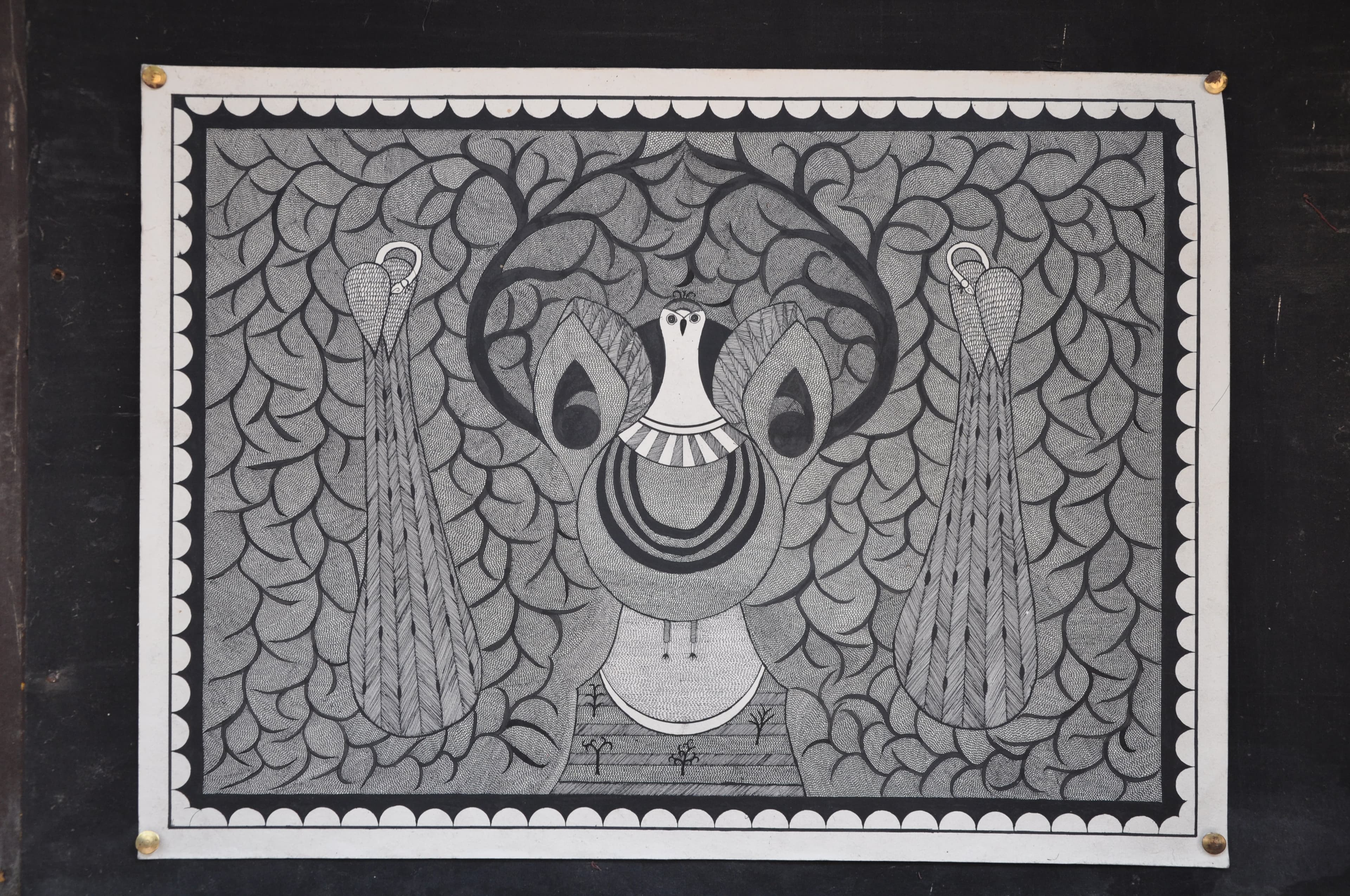
Mithila art comes from the Janakpur region of Nepal’s southern Terai, part of a single cultural region that straddles the border with India’s Bihar. That border region is where the alternative name Madhubani comes from. Traditionally, women painted these bold, symmetry-filled designs on their homes for weddings and festivals, passing the skill from mother to daughter. The motifs are joyful and crowded: deities, peacocks, fish, the sun and moon, with almost no empty space.

Since 1989, the Janakpur Women’s Development Centre has helped artists move the work onto paper, textiles, and ceramics while earning a fair income. To spot hand-painted work, look for faint feathering where the lines were drawn by hand and slight irregularities between repeated shapes; a print is perfectly sharp and symmetrical. It makes a colourful, flat-packing gift with a strong story behind it.
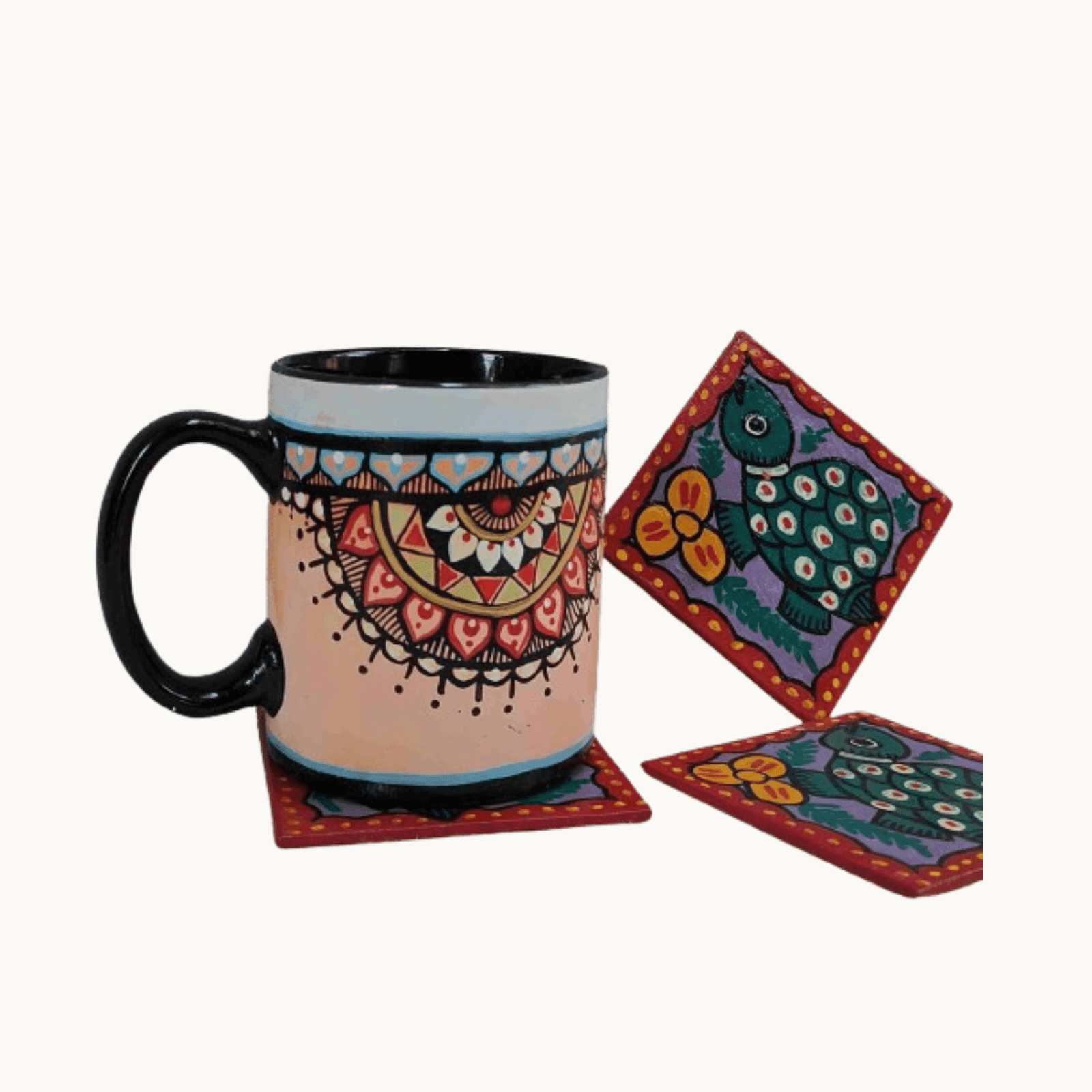
Look for hand-painted Mithila pieces — like a Mithila art coaster set (NPR 950) or a Mithila art mug (NPR 950). For the full story, read our guide to Mithila art and its Janakpur roots.
10. Lokta Paper Journals
Lokta is Nepal’s handmade paper, and it is wonderfully tactile. Makers harvest the inner bark of high-altitude Daphne shrubs. They then cook and hand-cast it into thick, textured sheets with soft deckle edges. Because the shrub regrows from its rootstock in a few years, well-managed lokta is a renewable craft, not a destructive one. It is also Nepal’s historic paper. Scribes once wrote government records and sacred texts on it, and the oldest surviving lokta manuscripts are over a thousand years old.

As souvenirs go, lokta is hard to beat. Journals, cards, gift wrap, and lampshades are light, affordable, and unmistakably Nepali. To check authenticity, look for feathered edges on all four sides and visible bark flecks; machine paper has clean-cut edges and a uniform surface. Note that lokta is traditionally prized as insect-resistant, a long-held belief rather than a lab-proven fact, so enjoy that as folklore.
A Jamarko handmade recycled notebook (NPR 450) is an easy pick, or browse the full lokta paper collection for journals and stationery.
11. Silver and Mohar-Coin Jewellery
Nepali silverwork ranges from delicate filigree to bold Tibetan-style pieces inlaid with turquoise and coral. One especially local idea is coin jewellery. The mohar was the silver coin of the old Kingdom of Nepal, in use until 1932, and Himalayan communities have long strung coins into necklaces as wearable savings. A pendant or pair of studs inspired by these coins carries a genuine slice of Nepali history.
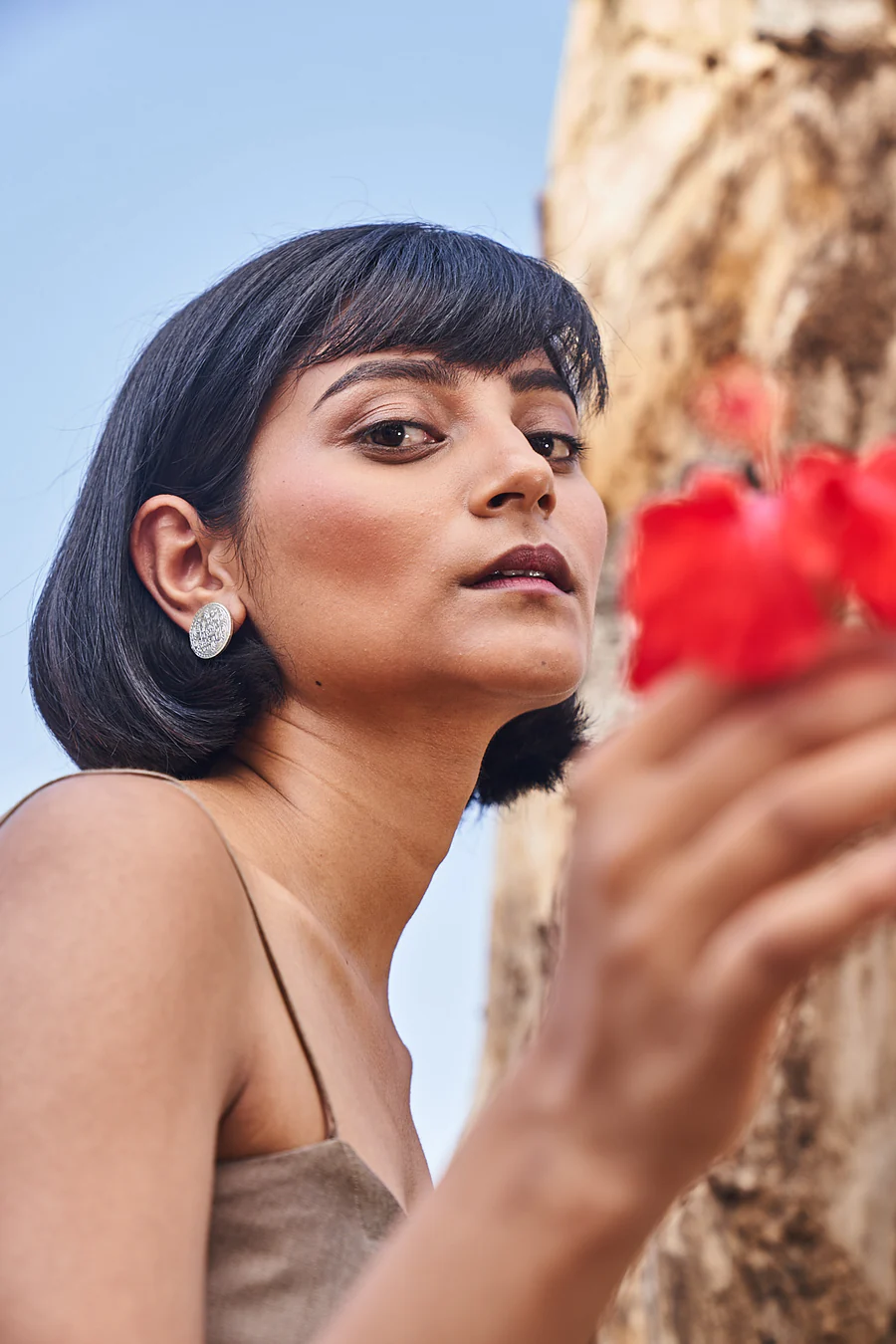
A buyer’s caution, though. “Tibetan silver” is a style and an alloy, not a purity promise, and Nepal does not enforce a national hallmark the way some countries do. Therefore, look for a “925” sterling stamp. Also ask for a VAT bill or purity note, and favour established jewellers over street stalls. If a price looks too low for the weight of metal, it is not solid silver.
Explore Nepali silver jewellery by NeNepal — including the Sikka Studs (NPR 3,500), modelled on an 18th-century mohar coin, and the Chandra Surya sun-and-moon earrings (NPR 4,500).
12. The Khukuri (Gurkha Knife)
The khukuri, with its forward-curving blade, is Nepal’s national knife and the famous sidearm of the Gurkha soldier. The British first met it during the Anglo-Nepalese War of 1814 to 1816. They began recruiting Gurkhas soon after. Today the knife still serves with both British and Indian regiments. A complete khukuri arrives with two small tools tucked in the scabbard: the karda, a little utility knife, and the chakmak, a blunt steel for honing the edge. The small notch near the handle, called the cho, has several traditional explanations, so nobody should claim a single definitive meaning.

For a working blade rather than a wall-hanger, look for high-carbon spring steel, a horn or hardwood handle, and a solid tang. The best come from forging towns like Bhojpur, Dharan, and Chitlang. Two practical points matter most, however. First, a khukuri is a blade, so it must travel in your checked luggage, never your carry-on. Second, a brand-new khukuri exports freely, but a genuine antique over 100 years old is protected and needs a Department of Archaeology certificate — which is covered next.
Himalayan Flavours and Wellness Souvenirs
If you want to know what to buy in Kathmandu for the kitchen, edible and wellness souvenirs are easy to share and pack flat. These three are distinctly Nepali — and one comes with a serious safety note.
13. Nepali Tea from Ilam
Nepal’s best tea grows in the eastern hills around Ilam, on the very same Eastern Himalayan ridge as India’s Darjeeling, just across the border. They share altitude, climate, and the same tea variety. As a result, a good Nepali orthodox tea offers Darjeeling-style character at a friendlier price. Look for “orthodox” whole-leaf tea rather than granular CTC. Then seek out a delicate first flush, the prized first spring plucking. It is a light, lovely, suitcase-friendly gift.

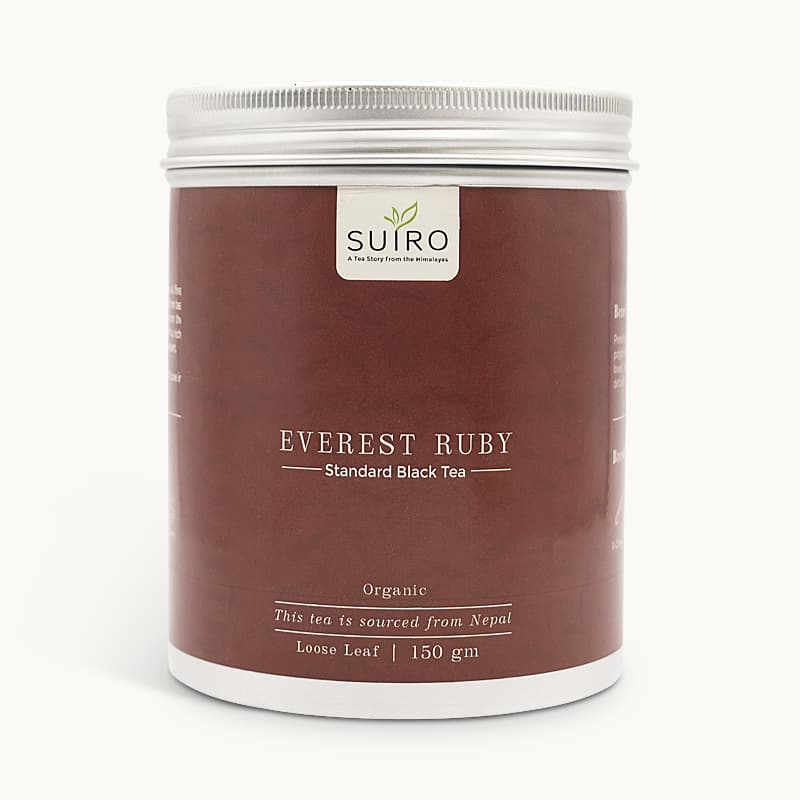
For a taste of Ilam, try Suiro Everest Gold pure black tea, 100g (NPR 1,900), or sample widely with the Pure Tea Art Box (from NPR 500). Explore the full Nepali tea collection for more.
14. Mad Honey
Mad honey is Nepal’s most talked-about novelty. Gurung honey hunters harvest it from the cliff nests of the giant Himalayan bee, Apis laboriosa. These bees feed on rhododendron flowers whose nectar contains a natural compound called grayanotoxin. That is what gives spring honey its mild, tingling, slightly intoxicating effect. It is a fascinating, very local gift — but it is a curiosity, not a daily honey.
Please treat it with respect, therefore. A tiny taste is the most anyone should try, and even small amounts can cause dizziness, nausea, or a drop in blood pressure and heart rate. So keep it well away from children, anyone who is pregnant, and anyone on heart or blood-pressure medication, and never serve it as ordinary honey.
If you do buy some, the Himaida Mad Honey, 200g (NPR 2,550) is responsibly sourced from Nepal’s mountains. First, though, read our full guide to mad honey for the history and the safety facts.

15. Shilajit
Shilajit is a sticky, tar-like mineral resin that seeps from Himalayan rocks at high altitude, and it has a long history in Ayurvedic tradition. Its prized component is fulvic acid, alongside a range of trace minerals. It packs small and feels wonderfully exotic, which makes it a popular wellness souvenir. The quality on the market, however, varies wildly.
So buy carefully. Because resin from the wrong source can concentrate heavy metals, choose a branded product that publishes a third-party lab report for heavy metals and fulvic acid. It is also wise to avoid unbranded “raw” resin from roadside stalls. Ignore the popular tip that “real shilajit dissolves in warm water,” too — it proves very little and detects none of the contaminants that actually matter.
A dependable option is the Himvat Shilajit with Ashwagandha, 30g (NPR 1,650), sourced from high-altitude Humla and traditionally purified. See the wider shilajit range, or read our full guide to Himalayan shilajit.

Looking for smaller, pack-flat extras? Nepali spices make great fillers: timur, the citrusy Himalayan Sichuan pepper with a gentle tingle, and jimbu, a dried Himalayan herb with an onion-garlic aroma. Both weigh almost nothing and flavour a kitchen back home for months.
Practical Tips for Shopping in Kathmandu
A little local know-how goes a long way. Here is how to shop smart, bargain fairly, and get your treasures home legally. For more, read our guide to avoiding tourist traps when shopping in Kathmandu.
Where to shop in Kathmandu
Knowing what to buy in Kathmandu is only half the fun. Knowing where to buy it is the other half. Each neighbourhood has its own character, so match the area to the gift:
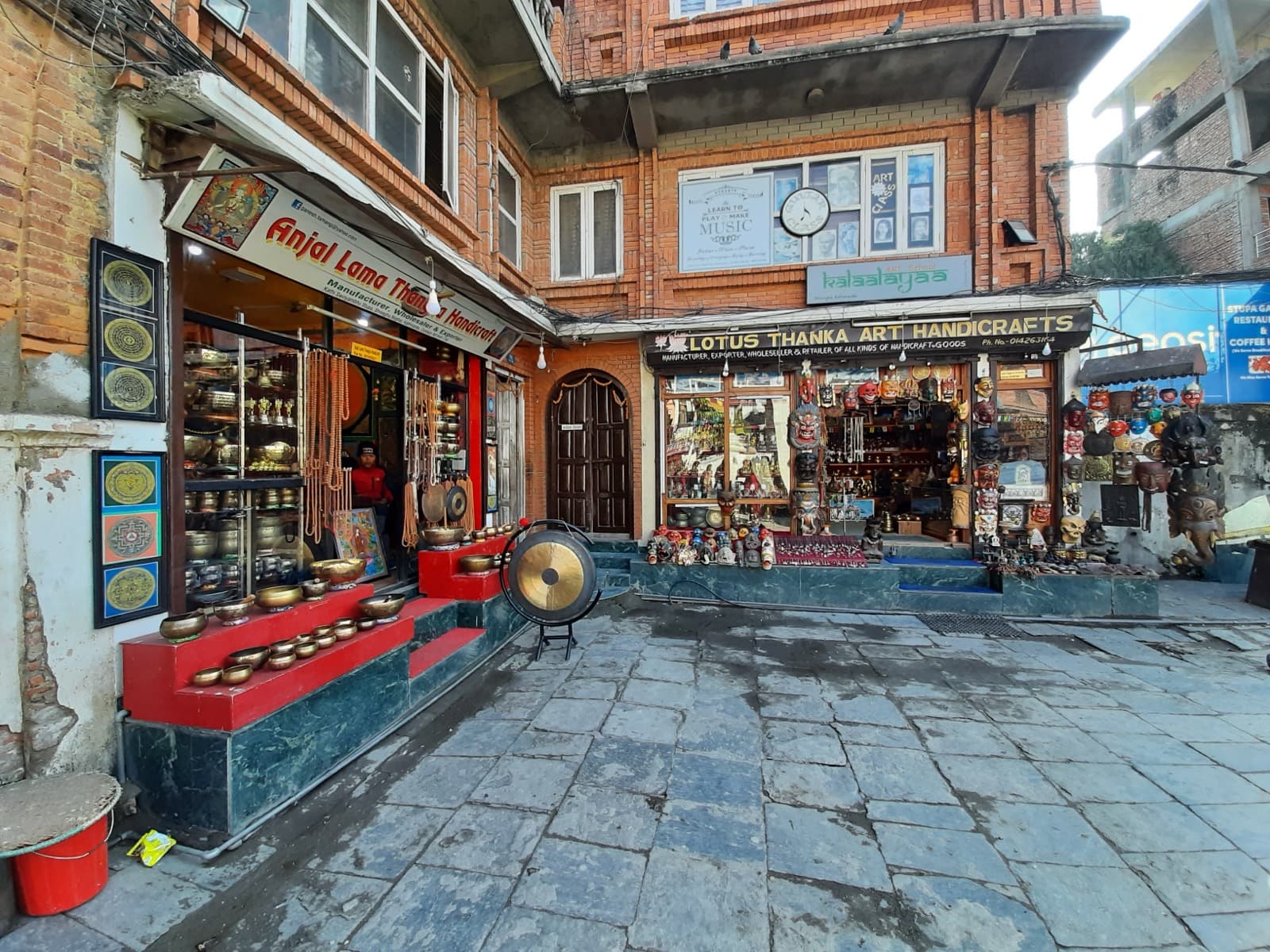
Thamel: the tourist hub for pashmina, singing bowls, khukuris, prayer flags, and outdoor gear. Choice is huge, but so is the markup, so bargain here.
Patan (Lalitpur): the home of fine metalwork, thangka, and silver. Visit fair-trade shops around Kupondol for fixed, honest prices.
Bhaktapur: the best place for Newari wood carving, pottery, and papier-mâché masks, bought close to the workshops.
Asan and Indra Chowk: the atmospheric local bazaars for spices, tea, beads, and everyday Nepali life.
How to bargain in Nepal
Bargaining is normal and expected in tourist markets and street stalls, but not everywhere. Fair-trade stores, supermarkets, and most modern boutiques use fixed prices, so do not haggle there. In the bazaars, however, opening quotes to tourists are often inflated. A common approach is to counter well below the asking price and meet somewhere in the middle, all with a smile. Treat the “start at half” idea as a loose guideline rather than a rule, and never grind hard over tiny sums — the goodwill is part of the experience.
Exporting antiques: the 100-year rule
This is the one rule worth memorising. Under Nepal’s Ancient Monument Preservation Act, any object more than roughly 100 years old is treated as a protected antique and cannot simply be carried out of the country. Anything newer counts as a “curio” and exports freely. So if a shopkeeper offers you a “genuine antique” thangka, idol, or khukuri to take home, be sceptical: a true antique cannot legally leave Nepal. For any old-looking or high-value piece, the Department of Archaeology at Ramshah Path in Kathmandu issues a free, same-day curio certificate that confirms it is fine to export.
A quick authenticity checklist
Pashmina: look for the Chyangra Pashmina trademark and a stated fibre content, not just the word “pashmina.”
Carpets: flip them over for a warp-extension fringe, and look for a numbered GoodWeave label.
Thangka: tilt it to the light — raised brushwork and uneven gold mean hand-painted; a flat dot pattern means a print.
Silver: check for a 925 stamp and ask for a bill.
Shilajit: insist on a third-party lab report.
What to Buy in Kathmandu: Frequently Asked Questions
What is Kathmandu best known for buying?
Kathmandu is famous for handicrafts: pashmina and cashmere shawls, hand-knotted Tibetan carpets, thangka and paubha paintings, the khukuri knife, Tibetan singing bowls, lokta-paper journals, and silver jewellery. For edible gifts, Nepali tea from Ilam, mad honey, and shilajit are the standouts. Most of these Nepal souvenirs are handmade, lightweight, and distinctly Nepali.
What should I buy in Kathmandu for a uniquely Nepali gift?
When you are deciding what to buy in Kathmandu for a uniquely Nepali gift, you have several strong options. Choose a Dhaka-fabric piece, a lokta-paper journal, an allo-fibre bag, a hand-painted Mithila artwork, or mohar-coin silver jewellery. These crafts are hard to find made authentically anywhere else, and each carries a clear regional story from Nepal’s hills and Terai.
How can I tell if a pashmina is real?
Do not rely on the ring test, which only shows the cloth is thin. Instead, look for the official Chyangra Pashmina trademark, read the stated fibre content (genuine pashmina is fine cashmere, sometimes blended with silk), and buy from association members or Patan cooperatives. A burn test can confirm a fibre is natural rather than synthetic, but it cannot prove the wool is pashmina.
Are Tibetan singing bowls actually ancient and Tibetan?
Mostly no. Although they are marketed as ancient Tibetan ritual instruments, scholars find no evidence of that traditional use, and the meditative “singing” practice spread in the West only from the 1970s. Most bowls today are made in the Kathmandu Valley from copper-tin bell metal. They are still lovely, well-crafted objects, so choose one by its sound rather than the backstory.
Can I take a khukuri knife on the plane?
Yes, but only in your checked luggage, well wrapped — never in your carry-on, as it is a blade. A brand-new khukuri exports from Nepal without any issue. Only a genuine antique over 100 years old is restricted and would need a Department of Archaeology certificate, so a normal souvenir khukuri is fine to fly home.
Is it safe to buy and eat mad honey?
Treat mad honey as a novelty, not a regular food. It contains natural grayanotoxins, so only a tiny amount is ever appropriate, and even then it can cause dizziness, nausea, or a drop in blood pressure and heart rate. Avoid it entirely if you are pregnant, giving it to children, or taking heart or blood-pressure medication, and buy from a reputable, responsibly sourced seller.
Can I export antiques and old religious items from Nepal?
No. Under the Ancient Monument Preservation Act, objects more than about 100 years old are protected and cannot be freely exported, so any “antique” offered to tourists is either not genuinely old or is being sold illegally. New handicrafts count as curios and export freely. For any questionable piece, the Department of Archaeology at Ramshah Path issues a free, same-day curio certificate.
Where is the best place to buy souvenirs in Kathmandu?
It depends on the item. Thamel has the widest selection of pashmina, singing bowls, and prayer flags, though you should bargain. Patan is best for thangka, metalwork, and silver, especially the fair-trade shops near Kupondol, and Bhaktapur is the place for wood carving and masks. For fixed honest prices, choose fair-trade outlets — or order from local makers for hotel delivery.
How much should I budget for souvenirs in Kathmandu?
It varies hugely by item. Lokta journals, prayer flags, and small Mithila pieces start around NPR 450 to 950. Dhaka accessories and silver studs run roughly NPR 2,000 to 4,500, while a fine pashmina, thangka, or hand-knotted carpet can reach many thousands. A realistic gift budget for a trip is NPR 10,000 to 30,000, stretched further by buying lighter crafts and edibles.
Do I need to bargain everywhere in Kathmandu?
No. Bargaining is expected in tourist markets and street stalls, but fair-trade shops, supermarkets, and many modern boutiques use fixed prices. In the bazaars, counter below the opening quote and settle in the middle, politely. In fixed-price stores, the marked price is the price, and it often supports artisans directly.
What are the best lightweight souvenirs from Nepal?
For easy packing, choose lokta-paper stationery, prayer flags, Dhaka ties and scarves, a pashmina shawl, Mithila coasters, Nepali tea, jimbu and timur spices, and a small allo wallet. They are flat, light, and inexpensive, which makes them ideal for gifts and for travellers watching their baggage allowance.
The Bottom Line
Kathmandu rewards the curious shopper. Behind almost every souvenir is a living craft — a weaver in Terhathum, a painter in Patan, a paper-maker in the hills — and choosing the authentic version supports those artisans directly. So use this guide on what to buy in Kathmandu to look past the mass-produced trinkets and pick souvenirs from Nepal that carry a real story instead.
And whatever ends up on your list, Avendi Local can deliver these maker-made Nepali crafts to your hotel the same day. That way you can spend your time exploring temples and mountains rather than hauling shopping bags. Safe travels, and happy shopping.
Short on time in Kathmandu?
Order authentic, maker-made Nepali souvenirs on Avendi and have them delivered to your hotel the same day — no Thamel markups, no haggling required.
Image credits: Thamel pashmina shop — Bijay Chaurasia (CC BY-SA 4.0); Dhaka topi — Ramnam (CC BY-SA 3.0); thangka — Mrs Cardboardbird (CC BY-SA 3.0); singing bowl — Serg Childed (CC BY-SA 4.0); Boudhanath prayer flags — Jorge Láscar (CC BY 2.0); Mithila painting — Mohitkiran (CC BY-SA 3.0); Ilam tea — Aaditya Poudel (CC BY-SA 4.0); Tibetan tapestry, Newari window, lokta paper, kukri & spice market — rawpixel / The Met / USAID (CC0). Via Wikimedia Commons and public-domain sources. Product photography courtesy of the makers via Avendi Local.